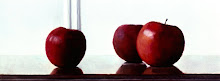
Click image below for more "still life"

Click image below for more "still life"
Francis Cunningham "Three Baldwin Apples" (1964) Oil on linen 5'' x 16''
Showing posts with label painting. Show all posts

Monday, September 30, 2013

Masters Exhibition and Opening Reception

The Masters Exhibition at the Century Association is currently ongoing and includes 23 original works of art and can be seen from October 2 through November 20, 2013.  

The Century Association is located at  7 West 43rd St,  NYC.

If you wish to view exhibition, see the address above and request to see the Francis Cunningham exhibition.  Hours are Monday thru Saturday, 9-3pm.

The opening reception was held on Wednesday, October 2 from 5pm - 7pm.

Francis is also be debuting his new book "Unframing the Nude". A labor of love that was 10 years in the making. 

From inside the front cover, "Francis Cunningham caught the attention of Ben Shahn at a Boston Museum summer school session in 1947, Cunningham was sixteen. Now, after a lifetime of painting, teaching and co-founding two New York art schools, he summarizes his experience in "Unframing the Nude". This book is about ways of seeing and the craft of painting; its focus is on transforming the naked human body into a nude.

"Unframing the Nude" is an incisive and personal account of a lifetime's work, an ardent sharing of accumulated knowledge that speaks to artists and viewers alike."


"With conviction and hope Cunningham has carried forward several long traditions in painting. His work continues not only the Renaissance humanistic practice of depicting the natural world and living men and women, but also the modern practice of discovering abstract forms in those things and letting those forms determine how they are painted"

- John Walsh, Director Emeritus, J. Paul Getty Museum

"Unframing the Nude" is available for pre-order. Please email for details and to reserve your copy today.


 We hope to see you at the Opening!

Thursday, September 19, 2013

Behind the Scenes with a Pair of Paintings
Reaching (Regina) and Reaching (Peter)


This week we will begin exploring a pair of paintings, Reaching (Regina) and Reaching (Peter).  As we have already explored the behind the scenes of Reaching (Regina), this week we will begin with Reaching (Peter). In following weeks we will take an in depth look at the role anatomy plays when painting figures.

They were not planned to be a pair of paintings.  Francis recalls being in his studio working on Reaching (Regina). When Peter saw the nearly finished painting, he laid down on the floor and took the pose you see in the painting. He took this pose as a natural response to the pose Regina was in.

Knowing the background on Peter may help to understand the acting out of his response to the painting as contrasted to a verbal description of what he was experiencing when he saw the painting.  In his younger years, Peter was an athlete. When he was in his early thirties he had a stroke that left him almost entirely paralyzed on his right side. If you look closely at his right arm and his right leg in the painting , you can see that they are not quite normal.  What you are seeing is not a mistake in the painting, it is capturing the truth of a particular model.

The stroke also affected Peter’s speech. He could no longer talk in words, he could only make guttural sounds to indicate yes, no or maybe.  These sounds are how Francis and Peter communicated. Peter is a very intelligent man and during his posing Francis conversed with him on a variety of subjects from philosophy to politics, literature and other subjects.  Francis continues to be amazed at the depth of the conversations they had with Peter’s limited means of conversation.  There was, in fact, much he could say with the expressions of his face and body and the inflections he would impose on the sounds he made to express his meaning.

One of the most important observations about Peter is that he is, like Regina, an anatomically functional nude.  Both figures appear able to get up and change pose. They are not locked into their position on the canvas. In general and in most paintings you will find that the figure is fixed in its position by gravity. For example, this may happen because the painting makes clear that the body is standing on the floor or seated in a chair or that an arm rests on a piece of furniture.

In Reaching (Regina), the figure is seen from above and is more directly lying flat on the floor than is Peter in his pose. He is in an unusual position. He is not positioned fully on his side - there are rotations. There is no definitive point where the disposition of his pose has been fixed. Taking this into consideration, you can turn the painting upside down or on   it’s edges and make an entirely different observation about what the subject is doing within the painting.

When John Walsh, former Director of the Getty Museum, first viewed Reaching (Peter), Francis turned the painting on it’s four  edges. Walsh was amazed at the impact he felt seeing the figure in a different position. 


When the painting was turned 90 degrees so  Peter's back faced up, Walsh remarked, "he’s just flying through the space!"  In this position you are no longer viewing a man lying on the ground, partially crippled, reaching out. Walsh remarked how his attention was drawn to the designs and shapes that occur at the back of Peter's right knee and on his left leg, to the shapes on the sole of the foot.

"How often do you stop to look at the sole of a foot?", Walsh asked. The anatomically functional nude is able to accomplish these different things but a painting or sculpture is of course static, so viewers will have to use their imagination empathetically to identify with the figure's immediate presence and with its ability to change positions.


With most of Francis’ paintings the figure is to some degree anchored by the nature of the pose. If a figure standing on the floor is turned upside down there still will be this figure standing on the floor, but seen upside down. With Peter, as you turn the painting, you will notice how completely he changes.  You see him first in his reaching pose and then as you turn him, so his back is facing up, he seems to be flying and what is a purple drapery on the floor becomes a cape. Turning the painting once again, he seems to be plunging with velocity downward.


The notion of asking the viewer to empathetically allow an anatomically functional figure to get up and move around was not a part of the requirements for a nude figure in classical art. The Greeks who could make the gods take human form were not concerned with this concept nor was it a concern in the Renaissance, where figures are designed to take their place on the canvas in an idealized form.

Francis regards these two paintings of Reaching (Regina) and Reaching (Peter) as expressions of what the anatomically functional bodies of a particular man and woman can accomplish today.  They bring an immediacy to the body and the human figure because of their potential for changing position and so Francis suggests they are not separated and apart from our space. They are in the room with you. While the viewer always seeks to bring a painted or sculpted figure to life, this particular kind of presence would not happen if these figures were not anatomically functional.

Next week, we will begin to delve into anatomy and the role it plays when painting figures. 

Come meet Francis in person at the Masters Exhibition Opening Reception, at the Century Association on October 2, from 5pm - 7pm. Just email fc@franciscunningham.com to receive a personal invitation from Francis.

Wednesday, August 24, 2011

Set-up, Color-spots, Clean-up with Francis Cunningham (Video)

Francis Cunningham is in the country, in his summer studio, painting while vacationing. Before he left we recorded some footage for the third in a series of video about the painting process. I've edited it into a new, hypnotic video. Hopefully it'll be as pleasant to watch Francis in his studio silently preparing for a short quite theoretical session of painting and at the end revealing some behind the scenes - cleaning-up, as it was recording and editing it. Here is the link to the whole series and below is the most recent video.

Tuesday, June 21, 2011

The Canvas and the Easel with Francis Cunningham

Today we're posting the second installment in the series about the painting process with Francis Cunningham. This video is about setting up the canvas on the easel and positioning the easel.

Mixing Color with Francis Cunningham

Two weeks ago we started a new video series in which Francis Cunningham will introduce technical basics of painting. Our first installment was on mixing color.

Wednesday, May 18, 2011

Francis Cunningham: One Year in Painting (Full Video)

Today, we are catching up with our blogging, having recently completed a couple of videos.  Weeks ago, we gave you a preview of a longer video we were working on, which was a video about the development of Francis Cunningham's large three figure piece (2009-2011). In the video Francis Cunningham talks about all the stages of the painting's development, ending with how to look at painting. His model makes a brief appearance, too.

Thursday, April 14, 2011

Grid/ Off the Grid Walk-through with Francis Cunningham (Video)

Francis Cunningham is in a group show, "Grid/ Off the Grid" at Westbeth focusing on the use of the grid in landscape. Most of the artists in the show, Violet Baxter, Bill Kennon, Simon Carr, Valerie Mendelson, Robert Feinland, Robert Ludwig, Francis Cunningham and Peter Colquhoun, live at Westbeth. We decided to do something new for our YouTube channel and cover the show with a long walk-through. The video is quite long, but with 60 or so paintings by eight artists, it was only fair to spend a long time with them in the great exhibition space Westbeth Gallery is.

More details on NY Art Beat http://www.nyartbeat.com/event/2011/672D
Note, the exhibition ends on Sunday, April 17, 2011.

Wednesday, April 6, 2011

New Three Figure Piece Opening Sequence (Video)

Francis Cunningham has just recently completed a major figure piece, which he's worked on with a model from December 2009. We announced it here and reported on the process here.  We've been documenting the process, between the painting sessions, on video and today we have the opening sequence of our 40 minutes video ready to share on YouTube.  Like a true painter's video, it'll be worked on for a while, but today, it wants to get out, at least in a small part.


Wednesday, February 16, 2011

Three Figure Piece Finished & Jerry Saltz's Abstract Manifesto

Since December 2009 Francis Cunningham has been working on a large, three-figure painting and today was the day he reached the final stage.  Today was also the day his model, who modeled for two of the three figures, was here probably for the last time.
I've been documenting the painting process in photographs and video, staying away from the studio, having Francis talk about the painting when the model was not here. Today we added a major amount of footage and the editing will begin very soon.


Some of the issues I've heard about from Francis that related to the just finished work as well as his life work in general was "abstraction" as a tool in representational painting. Color spots technique, the use of limited and specific palet are just the most immediately striking "abstract" tools in my view in the case of Francis Cunningham works.  He's some more to say about it in the long video we're making. Visit his YouTube channel here, to watch the growing collection of video commentaries by Francis Cunningham.

Aching to make a blog entry after a long hiatus here, I'd inadvertently brought it about by showing Francis, related to our talks about abstraction, “The Jerry Saltz Abstract Manifesto, in Twenty Parts." This telling manifesto, which struck a chord with Francis Cunningham, is an answer to a seemingly simple question, posed by a reader of Jerry Saltz's art column in New York Magazine. The manifesto has been circulating Facebook, Twitter and art blogs. You can read it in the magazine here along with two other another questions and answers, or below:


Dear Jerry,

Over the past few years, I've noticed a lot more abstract art being made, and I often find myself stymied by something a little bit embarrassing. Jerry, is abstract art for real? I mean, I often don't really get it. Isn't it just smudges and stripes and squares and stuff?
—Embarrassed
Dear Embarrassed,
You are not alone. I too have heretical thoughts like yours. It can also take 30 years to understand why an all-white painting by Robert Ryman or a pencil grid on canvas by Agnes Martin is art.
I can't tell you what abstraction is, but I can tell you a number of things that I think that it allows artists to do. What I say about abstract art could also be applied to representational art. With that in mind here's “The Jerry Saltz Abstract Manifesto, in Twenty Parts."
1. Abstraction is one of the greatest visionary tools ever invented by human beings to imagine, decipher, and depict the world.
2. Abstraction is staggeringly radical, circumvents language, and sidesteps naming or mere description. It disenchants, re-enchants, detoxifies, destabilizes, resists closure, slows perception, and increases our grasp of the world.
3. Abstraction not only explores consciousness — it changes it.
4. All art is abstract. A painting of a person or a still-life is a two-dimensional representation of three-dimensional reality and therefore infinitely abstract. Whenever an artist sets out to make something it turns into something else that he or she could never have imagined or predicted.
5. Think of an abstract painting as very, very low relief — a thing, not a picture.
6. Abstraction exists in the interstices between the ideal and the real, symbol and substance, the optic and the haptic, imagination and observation.
7. Abstraction brings the world into more complex, variable relations; it can extract beauty, alternative topographies, ugliness, and intense actualities from seeming nothingness.
8. Abstraction, like ideas, intuitions, feelings, and life, is not mimetic.
9. Abstraction is as old as we are. It has existed for millennia outside the West. It is present on cave walls, in Egyptian and Cypriot Greek art, Chinese scholar rocks, all Islamic and Jewish art — both of which forbid representation. Abstraction is only new in the West.
10. Abstraction gained ground in Western art after centuries of more perfected systems of representation. By the mid-nineteenth century, representation felt like a trap, and seemed empty, false, or limiting. A similar situation existed in the early aughts, after artists of the nineties re-deployed realisms in numerous ways. The field appeared closed off for younger artists. That’s why contemporary artists have not only begun to reexplore the possibilities of abstraction, they’re shedding much of the Greenbergian cant and academic-formalist dogma that attached themselves to it over the last 50 years. Abstraction is breaking free again.
11. Abstraction offers ways around what Beckett called “the neatness of identification.”
12. Rothko’s glowing floating rectangles of color are more than abstract patterns. They are Buddhist TVs or what Keats called “good oblivion. One sees what nothing looks like in them. They make you ask, “What light through yonder painting breaks?” (Now do you see how full emptiness and abstraction can be?)
13. Abstraction is just a tool. It is no less “real” than philosophy or music.
14. Abstraction is something outside of life that allows us to be present at our own absence or alternatively absent in our own presence.
15. Abstraction creates patterns of meaning and its own extremely flexible intricate syntax. It is astral synthesis.
16. Abstraction teeters on making empty gestures while also making deep statements.
17. The camera was supposed to supplant painting but didn't. Instead, painting — ever the sponge, always elastic — absorbed it and discovered new realms.
18. Abstraction may speak in a sort of intra-species visual-electronic-chemical-pheromonal code, creating optical-cerebral networks and wormholes, organic maps of unknown yet familiar territories, may have a kind of plant intelligence that allows it to grow, proliferate, flower, change directions, and survive relentless aesthetic predation from a lay public.
19. Abstraction contains multitudes.
20. I’ve left out No. 20, because I want to hear your opinion: What else does abstraction do that’s special? Comments are open below.
By Jerry Saltz

Francis Cunningham has yet to add #20 as invited by the author above.


Wednesday, November 10, 2010

New three-figure piece, progress report in pictures.

It's been almost a year since Dick started the most recent figure piece. We've been trying to document it at various stages. Below we go chronologically to show the process in a few images.

As always for a large work, Dick starts with a map.

The map. December 2009

The map is transferred to the canvas and followed by an under-painting.

Partial underpainting. December 2009

Here are the first color spots.

First spot. December 2009

Color-value relationships (color spots) are  abstracted directly from the appearance of nature.  Every edge is defined by color-value on either side of the edge. Three-dimensional form and space are produced by these visually observed relationships.

3.31.2010
Israel Hershberg remarked on how abstract the process is.
10.28.2010
Many sessions later, the painting is still in progress.

Thursday, May 13, 2010

Arthur Cohen & Francis Cunningham Exhibition, May 2010 in Red Bank NJ


Those who could not make it to Francis Cunningham and Arthur Cohen "The Landscape Cape Code and the Berkshires" show's opening reception at Laurel Tracey Gallery last weekend, we managed to glean some images from the gallery and a guest and bring your a slideshow.  Click here for the slideshow. You can also see the exhibition at the gallery until May 20, 2010.
Laurel Tracey, Francis Cunnigham, Arthur Cohen, Kitty Cunningham before the show in the gallery.

Arthur Cohen, who is showing Provincetown Harbor paintings in the exhibition, just like Francis Cunningham studied with Edwin Dickinson, although at an earlier time.  Laurel Tracey Gallery page says the following about Arthur Cohen, his style and technique:

Cohen's sweeping panoramas of Provincetown Harbor are developed from storied layering and scraping - thin levels of paint build up over a day. week, or even over several years, referred to by Cohen as the "ghost" in his painting. It is this "buried" sense of time and continuity that evokes a sense of timelessness and spatial infinity. Working with a focused palette of blues and grays, occasionally some pink and green, Cohen repeatedly brings the viewer a synthesis of light from different moments;

Keeping in mind the common denominator, it is interesting to see the difference and similarities between the two painters' work in this exhibition.

Thursday, April 1, 2010

Still Life with Basket Gourds and Oranges (1967)

From the figure we're turning to still life, in particular to Still Life with Basket Gourds and Oranges (1967) oil on linen 34 x 40 in. 
In part one of the video Dick talks about the root of painting being a lived experience.


In part two we take up composition on the flat surface and in depth.


In part three we consider light, flatness and space.


...and all of it with a dash of Cezanne and a few others.

Friday, March 5, 2010

Further Thoughts on the Nude: The Relationship of the Contemporary to the Classical (Part 3/3)

Francis Cunningham On the Beach, Tom Johnson (1997) oil on linen 55 x 70 in.
Francis Cunningham Man Walking (1999) oil on linen 72 x 36 in. Private Collection.

In being open to the particular model one opens up the entire range of human expression through the body. When the model is nude one experiences this directly, unencumbered by baggage. It is shown by the small patterns within the larger movements. These are the adjustments, the little give-aways that a Nureyev, Baryshnikov or any great dancer or actor will show you and which will pass by you in a flash. They color the movement. They are expressed in painting and sculpture by what I call the designs within the design. But unlike acting, dance, movies or video, in painting and sculpture one has the opportunity to explore these designs at leisure, to meditate, examine and ponder.
Francis Cunningham Two Figures, Red Background (1992) oil on linen 78 x 52 in.
          I am also suggesting the reintroduction of reason and science into the artistic process – not in the sense of technology as in video and computer art, but science taken as the rational and experimental study of a subject, here the nude. We have gone past the anatomy of Leonardo and Michelangelo, codified in the 16th century by Vesalius. As expressions of their world they are, in a sense, as out-of-date as are the politics of the 16th century Italian city-states. But, and it is a large “but,” the raw information that Leonardo and others developed and that Vesalius formulated is still valid and the mass concepts and form theory developed and practiced in the Renaissance are as valid today as they were then. So also is the classical attitude towards humanity in so far as it is civilizing and humane. It is just that we have broadened the scope of anatomy, movement, gesture and our attitude toward the human being.
In taking on the particular individual nude as subject for painting and sculpture I am not advocating license, crassness or whatever may be demeaning. 
Philip Pearlstein Male and Female Models With Balloon Chair and Old African Drum (2000) Courtesy Betty Cuningham Gallery, New York
                                            Odd Nerdrum Iron Law (1984) 115 x 82.7 in.
                                              Lucian Freud Lying by the Rags (1989-1990)
                                         
The body is magnificent in how it functions, noble and as intrinsically beautiful in its daily self as anything depicted in classical art.
How you view the world will determine what you see.
                                                                                       *****************

Addendum 
December 26, 2009 
and 
February 24, 2010 

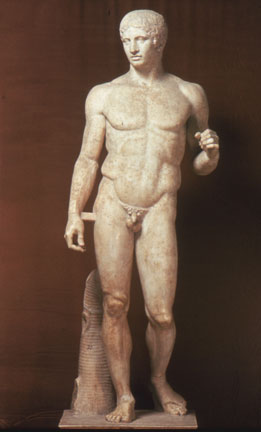
 Polykleitos Doryphoros ca. 450-40 B.C. from Pompeii, marble, 212 cm. Naples, Museo Archaeologico
Why the anatomically functional figure?  I regard myself as a classicist.  I go back to Greece, to my experience of Polykleitos and Phidias in Naples, the real presence of the human being in art, not just the human body.  If the Greeks in fact confined the human being to a few poses and to one or two points of view – station points from which to view the work – their figures feel real, existing as real presences.

                           Francis Cunningham Regina Standing Side View ('07-08) oil on linen 80 x 36 in. 
With the anatomically functional figure the figure feels real from many points of view, because it is not confined to its position on the canvas or as sculpture, but communicates its capacity to move about and take other positions.  Furthermore, expressively, it is not confined to a few poses and to those proportions which are defined as beautiful, but it opens up the whole range of expression through the unrestricted range of the body’s positions. 
                                       Francis Cunningham Reaching - Regina ('93-96) oil on linen 72 x 48 in. Private Collection.


                                            Francis Cunningham Reaching-Peter (1994-96) oil on linen 72 x 48 in.
For the Greek artist, the body and spirit are one.  So they are with me, and what I have sought to do is to bring the intellect, emotion and spirit back into the body. 
      In comparison, the “New Realism,” as Philip Pearlstein embodied it, intentionally avoids narrative and the intellectual, spiritual and emotional life of the subject.  The press release for “Pearlstein/Held: Five Decades” at Betty Cuningham gallery, November 19, 2009 – February 13, 2010, comments that, “By the late 1960’s Pearlstein had committed to the ‘New Realism,’ as stated in John Perrault’s manifesto:
No stories; no allegories; no symbols. 
No hidden meanings; no obvious meanings.
No philosophy, religion, or psychology.
No jokes.
No political content.
No illustration.”
Philip Pearlstein Two Nudes in Studio (1965) Oil on canvas 24 x 18 in.  Westheimer Family Collection © Philip Pearlstein
     
We had to have Pearlstein – we are lucky to have him – because, as he has said, “I rescued the human figure from its tormented, agonized condition given it by the expressionistic artists and the cubist dissectors and distorters of the figure, and at the other extreme I have rescued it from the pornographers, and their easy exploitations of the figure for its sexual implications.”  This quote, from Irving Sandler’s essay for the Betty Cuningham show, is followed by, “Unlike painters of the nude in the past, Pearlstein continues to portray what he sees without interpretation.” 
      Likewise, I portray what I see without interpretation.  I do not interpret, I present.  Pearlstein had to strip away all the barren and sterile expressionist, cubist and neo-classical baggage that hung around the human figure.  He cleared the decks.  It was a prodigious achievement.  It makes possible tearing down the barrier Kenneth Clark describes between the naked individual and the nude. 
                                           Francis Cunningham Three Figures (1993-99) oil on linen 72 x 96 in.
     
What I “see,” and this is tightly bound to the color-spots and the specific individual human being, has been described by Martin Sheen, the actor: “If you don’t leave home with the true sanctity of being, you won’t see that sanctity in anyone else.”  I see that sanctity in every person I have painted, nude or clothed, not because I approach them from a theologically intellectualized point of view but because I am convinced and awed by the universals of geometry, arcs and angles, and the staggering uniqueness of the color-values seen from my station point, unrepeated and unrepeatable. 
      A friend, author and educator, on seeing the figure of Genay Sundra in Three Figures remarked, “She is a goddess.”  For me, the gods and goddesses of antiquity and idealized form are as dead as they are to Pearlstein and other figure painters of today, but I have found also that they are not truly dead; they have simply moved into individual human beings.  I say this not because I “think” this or would like to believe it, but because this is what I see.  


Wednesday, February 10, 2010

Portraits: Backgrounds

The father of Dick's current model, Stephanie, remarked on the variety of backgrounds for Dick's figures,
which often contrast the realism of the bodies. This remark made Dick think about the various abstract
and figurative backgrounds he's used. The following video shows examples of those backgrounds,
how they came to be used and how they work with the figure.

Portraits: Tom Johnson

Today we're posting another portrait. This time it's a model, Tom Johnson, whom Dick painted in four major works. The video tells the story of Tom, as Dick knew him, from before they met until Tom's death.

Tuesday, February 2, 2010

Design Within Design Cont.

About a week ago, we posted on Designs within Design and we heard from many of you. Dick realized that there is more to say on the subject of designs within the design as well as framing and composition and we made this follow up video.

Saturday, January 23, 2010

Designs within Design


Yesterday was supposed be our video editing day- finish another portrait- but we started late and decided to make a short pretty unedited video about the concept of "designs within the design."  The idea of the designs with design define quite well, although not completely, Dick's painting process.
So, for the video, using one of his older, small, premiere coup landscapes, which he had used to create a background for a large nude of Tom Johnson- whose video portrait is coming soon- Dick illustrates how a viewer's eyes enter the painting through the edges of the painting. He flips the painting to its sides and upside down to analyze the framing, a great, simple tool in painting, photography and critical tradition, to get a better sense of space and the painting's compositional organization.
He then moves to another painting, the work in progress, the three figure piece, and reveals a stages in his color-spot process and the way he arrives at designs within the design of the picture as a whole.

Friday, December 18, 2009

The End Game Never Ends, and Self-Portrait

While I'm editing portraits, Dick is among other projects working on the three figure painting, which yesterday got its first spots of color. He's also touching up some nudes that we'll video very soon.


And then the most novel and fun for me at the moment, Dick has been pulling out various paintings from years ago which exhibit such variety of style. One of such paintings is a self-portrait as a "married buck right out of art school" with some early painting in the background done from the head, not nature.

Wednesday, November 18, 2009

Summer '09 Still Life: Studio in NYC. On the Golden Section Ratio

I originally planned two short videos on Dick's summer-long project, still life done in the Berkshires, but it ended up being three videos because of the amount of great material Dick discussed on camera. So, below is the video, part 2, recorded in Dick's NYC studio in which he discusses and explains his use of the golden section ratio in "organizing the surface of the canvas and its relationship to the space in the painting." If you have not yet seen part here it is  on YouTube and here is our blog entry on it.