Francis Cunningham On the Beach, Tom Johnson (1997) oil on linen 55 x 70 in.
Francis Cunningham Man Walking (1999) oil on linen 72 x 36 in. Private Collection.
In being open to the particular model one opens up the entire range of human expression through the body. When the model is nude one experiences this directly, unencumbered by baggage. It is shown by the small patterns within the larger movements. These are the adjustments, the little give-aways that a Nureyev, Baryshnikov or any great dancer or actor will show you and which will pass by you in a flash. They color the movement. They are expressed in painting and sculpture by what I call the designs within the design. But unlike acting, dance, movies or video, in painting and sculpture one has the opportunity to explore these designs at leisure, to meditate, examine and ponder.
Francis Cunningham Two Figures, Red Background (1992) oil on linen 78 x 52 in. I am also suggesting the reintroduction of reason and science into the artistic process – not in the sense of technology as in video and computer art, but science taken as the rational and experimental study of a subject, here the nude. We have gone past the anatomy of Leonardo and Michelangelo, codified in the 16th century by Vesalius. As expressions of their world they are, in a sense, as out-of-date as are the politics of the 16th century Italian city-states. But, and it is a large “but,” the raw information that Leonardo and others developed and that Vesalius formulated is still valid and the mass concepts and form theory developed and practiced in the Renaissance are as valid today as they were then. So also is the classical attitude towards humanity in so far as it is civilizing and humane. It is just that we have broadened the scope of anatomy, movement, gesture and our attitude toward the human being.
In taking on the particular individual nude as subject for painting and sculpture I am not advocating license, crassness or whatever may be demeaning.
Philip Pearlstein Male and Female Models With Balloon Chair and Old African Drum (2000) Courtesy Betty Cuningham Gallery, New York
Odd Nerdrum Iron Law (1984) 115 x 82.7 in. Lucian Freud Lying by the Rags (1989-1990)
The body is magnificent in how it functions, noble and as intrinsically beautiful in its daily self as anything depicted in classical art.
How you view the world will determine what you see.
*****************
Addendum
December 26, 2009
and
February 24, 2010
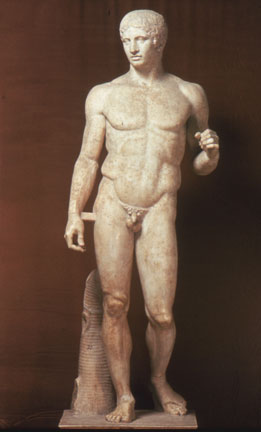
Polykleitos Doryphoros ca. 450-40 B.C. from Pompeii, marble, 212 cm. Naples, Museo Archaeologico
Why the anatomically functional figure? I regard myself as a classicist. I go back to Greece, to my experience of Polykleitos and Phidias in Naples, the real presence of the human being in art, not just the human body. If the Greeks in fact confined the human being to a few poses and to one or two points of view – station points from which to view the work – their figures feel real, existing as real presences.
Francis Cunningham Regina Standing Side View ('07-08) oil on linen 80 x 36 in.
With the anatomically functional figure the figure feels real from many points of view, because it is not confined to its position on the canvas or as sculpture, but communicates its capacity to move about and take other positions. Furthermore, expressively, it is not confined to a few poses and to those proportions which are defined as beautiful, but it opens up the whole range of expression through the unrestricted range of the body’s positions.
Francis Cunningham Reaching - Regina ('93-96) oil on linen 72 x 48 in. Private Collection.
Francis Cunningham Reaching-Peter (1994-96) oil on linen 72 x 48 in.
For the Greek artist, the body and spirit are one. So they are with me, and what I have sought to do is to bring the intellect, emotion and spirit back into the body.
In comparison, the “New Realism,” as Philip Pearlstein embodied it, intentionally avoids narrative and the intellectual, spiritual and emotional life of the subject. The press release for “Pearlstein/Held: Five Decades” at Betty Cuningham gallery, November 19, 2009 – February 13, 2010, comments that, “By the late 1960’s Pearlstein had committed to the ‘New Realism,’ as stated in John Perrault’s manifesto:
No stories; no allegories; no symbols.
No hidden meanings; no obvious meanings.
No philosophy, religion, or psychology.
No jokes.
No political content.
No illustration.”
Philip Pearlstein Two Nudes in Studio (1965) Oil on canvas 24 x 18 in. Westheimer Family Collection © Philip Pearlstein
We had to have Pearlstein – we are lucky to have him – because, as he has said, “I rescued the human figure from its tormented, agonized condition given it by the expressionistic artists and the cubist dissectors and distorters of the figure, and at the other extreme I have rescued it from the pornographers, and their easy exploitations of the figure for its sexual implications.” This quote, from Irving Sandler’s essay for the Betty Cuningham show, is followed by, “Unlike painters of the nude in the past, Pearlstein continues to portray what he sees without interpretation.”
Likewise, I portray what I see without interpretation. I do not interpret, I present. Pearlstein had to strip away all the barren and sterile expressionist, cubist and neo-classical baggage that hung around the human figure. He cleared the decks. It was a prodigious achievement. It makes possible tearing down the barrier Kenneth Clark describes between the naked individual and the nude.
Francis Cunningham Three Figures (1993-99) oil on linen 72 x 96 in.
What I “see,” and this is tightly bound to the color-spots and the specific individual human being, has been described by Martin Sheen, the actor: “If you don’t leave home with the true sanctity of being, you won’t see that sanctity in anyone else.” I see that sanctity in every person I have painted, nude or clothed, not because I approach them from a theologically intellectualized point of view but because I am convinced and awed by the universals of geometry, arcs and angles, and the staggering uniqueness of the color-values seen from my station point, unrepeated and unrepeatable.
A friend, author and educator, on seeing the figure of Genay Sundra in Three Figures remarked, “She is a goddess.” For me, the gods and goddesses of antiquity and idealized form are as dead as they are to Pearlstein and other figure painters of today, but I have found also that they are not truly dead; they have simply moved into individual human beings. I say this not because I “think” this or would like to believe it, but because this is what I see.