Last week this entry http://franciscunningham.blogspot.com/2011/04/inventory-learning-to-paint-nude.html#comments on our blog got a comment from Larry Groff who thanked us for putting together a great blog for painters. We were especially pleased to learn that he likes our videos.
He left us a link to his own blog http://paintingperceptions.com/ where he interviews and posts extensively about what he calls perceptual painting. Many of the painters discussed on the blog are Francis Cunningham's peers such as Israel Hershberg, a former student and teachers such as Robert Beverly Hale, to mention two.
Larry Groff is an avid art blogger, both blogging about perceptual painting in general at http://paintingperceptions.com/ and about his own work on his own website and blog http://larrygroff.com/blog/.
His blog is a goldmine including lots of great links to other art bloggers and blogging painters as well as original writing.
Showing posts with label art history. Show all posts
Showing posts with label art history. Show all posts
Wednesday, May 18, 2011


Thursday, November 4, 2010
Vilhelm Hammershoi Exhibition Catalog
Today I'm posting a video, which we hope will be the beginning of a new series of video art books and catalogs reviews by Francis Cunningham. We used Dick's no longer brand new, still digital camera.
This series was inspired by a magazine review series by graphic designer Michael Bojkowski in London called Reading List.
So here is the Danish painter Vilhelm Hammershoi's 1997 Copenhagen, Ordrupgaard
Museum and Musee d'Orsay exhibition catalog review.
This series was inspired by a magazine review series by graphic designer Michael Bojkowski in London called Reading List.
So here is the Danish painter Vilhelm Hammershoi's 1997 Copenhagen, Ordrupgaard
Museum and Musee d'Orsay exhibition catalog review.
Wednesday, April 21, 2010
It's 1975. "Patrick" and the New York scene.
Today we have a story from 1975, of course from the New York art scene involving Dick's exhibition. In order to set it against the historical background we go to Wikipedia where we find this handy chart about art movements from the 1950s to 2000s.

We look in the column devoted to the 1970s and find a handy list of hot movements of the time, but not what else artists are doing. Our blog entry halts and we have to find a better source of information on the period. We're interested in the stable of the Castelli Gallery as it is a good measure of what is going on in New York major galleries in that decade than the rather new movements listed on Wikipeidia, and we find the exhibition history on the gallery website. Here is how 1975 looks at Leo Castelli.
 In short, Castelli is showing abstraction and pop art. That leads us to assume, perhaps too soon, but our time is limited today, that there is little coverage of the kind of representational painting Dick does. We make a short stop at Allan Frumkin Gallery, today know as George Adams which is known for representing figurative artists such as Jack Beal and Philip Pearlstein. Here is a statement from their website.
"REALIST AND FIGURATIVE ART The gallery has long been known for representing Realist and Figurative artists such as Jack Beal and James Valerio as well as handling works by Alfred Leslie and Philip Pearlstein."
We don't find anything on what the gallery is showing in the 1970s and we move on to the generals.
Another element to the backdrop of what Dick is doing at the time is the photorealist movement beginning late 1960s and early 1970s, a reaction to Abstract Expressionism and Minimalism. While the Abstract Expressionists, Minimalists and Photorealists are fighting it out, from what Dick tells us, Philip Pearlstein and Lennart Anderson are painting nudes and showing in New York galleries.
In 1975 Dick has a show in New York which features life-sized figures, including nudes such as "Patrick."
"Patrick" is in the European tradition of the idealized nude- three-dimensional and standing in space- except that he's a particular human being.

Here is the story;
"This painting of "Patrick" was taken down from the walls of a prestigious New York gallery without my knowledge and put in a back room. It was 1975 and the occasion was my third one-man show which, in addition to still-life and landscape, included four life-sized clothed figures and four life-siize nudes.
That Saturday opening I bounded up the stairs to the main second floor gallery to be congratulated, coming down, by the man who had introduced me to the gallery. He never spoke to me again. On the following Tuesday my sister-in-law saw the show and called, saying that she had seen a man waving a catalogue and wondering where the painting of "Patrick" was? A gallery attendant then ushered him in to a back room, and she followed.
At the age 44 and in full stride I was still an innocent about the art world. I called Walter Terry, dean of American dance critics and a friend of my wife's and also myself, and I said, "Walter, what do I do"? The reply came without hesitation- "go to the gallery and them them either it goes up or the whole show goes down."
I did that. Well, I brought out the sweat on the gallery owner's upper lip. Not a good sign. He said the head of a company was coming in to buy a large, million dollar unfinished sketch by Claude Monet of his house-boat, and that the man's wife had died of cancer and that he'd be upset. The conversation continued on until I said, "Look. When he comes in, detain him on the first floor, take the painting down, and put it up when he leaves." "Hooray," the dealer said, "Cunningham has got the answer." A few weeks later the letter came, saying I'd never have a one-man show there again.
When the head of the Brooklyn Museum Art School, where I would teach for 18 years, Augustus Peck, heard about this he said, "You'll get a gallery in New York, but you'll never get a good one." Gus Peck was wrong on one count; I have had no gallery in New York, good or bad.
Why were the powers-that-be-disturbed by a particular, male, human being, nude? Why are some people still disturbed? Is it the male nude? Is it the particularity?
Today is not 1975. We have had far more exposure to the body through television, movies and the performing arts. We have now reality TV and "The Biggest Looser," where we see 350 or 400 pound bodies, but I suspect we're as much voyeurs now as we were then- afraid of our own bodies, looking at them with something between shame and distrust.
Let's look at "Patrick" as being ahead of its time in taking up the nude in the classical art form but with the subject, a particular human being.
-Francis Cunningham"

We look in the column devoted to the 1970s and find a handy list of hot movements of the time, but not what else artists are doing. Our blog entry halts and we have to find a better source of information on the period. We're interested in the stable of the Castelli Gallery as it is a good measure of what is going on in New York major galleries in that decade than the rather new movements listed on Wikipeidia, and we find the exhibition history on the gallery website. Here is how 1975 looks at Leo Castelli.

"REALIST AND FIGURATIVE ART The gallery has long been known for representing Realist and Figurative artists such as Jack Beal and James Valerio as well as handling works by Alfred Leslie and Philip Pearlstein."
We don't find anything on what the gallery is showing in the 1970s and we move on to the generals.
Another element to the backdrop of what Dick is doing at the time is the photorealist movement beginning late 1960s and early 1970s, a reaction to Abstract Expressionism and Minimalism. While the Abstract Expressionists, Minimalists and Photorealists are fighting it out, from what Dick tells us, Philip Pearlstein and Lennart Anderson are painting nudes and showing in New York galleries.
In 1975 Dick has a show in New York which features life-sized figures, including nudes such as "Patrick."
"Patrick" is in the European tradition of the idealized nude- three-dimensional and standing in space- except that he's a particular human being.

Here is the story;
"This painting of "Patrick" was taken down from the walls of a prestigious New York gallery without my knowledge and put in a back room. It was 1975 and the occasion was my third one-man show which, in addition to still-life and landscape, included four life-sized clothed figures and four life-siize nudes.
That Saturday opening I bounded up the stairs to the main second floor gallery to be congratulated, coming down, by the man who had introduced me to the gallery. He never spoke to me again. On the following Tuesday my sister-in-law saw the show and called, saying that she had seen a man waving a catalogue and wondering where the painting of "Patrick" was? A gallery attendant then ushered him in to a back room, and she followed.
At the age 44 and in full stride I was still an innocent about the art world. I called Walter Terry, dean of American dance critics and a friend of my wife's and also myself, and I said, "Walter, what do I do"? The reply came without hesitation- "go to the gallery and them them either it goes up or the whole show goes down."
I did that. Well, I brought out the sweat on the gallery owner's upper lip. Not a good sign. He said the head of a company was coming in to buy a large, million dollar unfinished sketch by Claude Monet of his house-boat, and that the man's wife had died of cancer and that he'd be upset. The conversation continued on until I said, "Look. When he comes in, detain him on the first floor, take the painting down, and put it up when he leaves." "Hooray," the dealer said, "Cunningham has got the answer." A few weeks later the letter came, saying I'd never have a one-man show there again.
When the head of the Brooklyn Museum Art School, where I would teach for 18 years, Augustus Peck, heard about this he said, "You'll get a gallery in New York, but you'll never get a good one." Gus Peck was wrong on one count; I have had no gallery in New York, good or bad.
Why were the powers-that-be-disturbed by a particular, male, human being, nude? Why are some people still disturbed? Is it the male nude? Is it the particularity?
Today is not 1975. We have had far more exposure to the body through television, movies and the performing arts. We have now reality TV and "The Biggest Looser," where we see 350 or 400 pound bodies, but I suspect we're as much voyeurs now as we were then- afraid of our own bodies, looking at them with something between shame and distrust.
Let's look at "Patrick" as being ahead of its time in taking up the nude in the classical art form but with the subject, a particular human being.
-Francis Cunningham"
Friday, March 5, 2010
Further Thoughts on the Nude: The Relationship of the Contemporary to the Classical (Part 3/3)

Francis Cunningham On the Beach, Tom Johnson (1997) oil on linen 55 x 70 in.


Francis Cunningham Man Walking (1999) oil on linen 72 x 36 in. Private Collection.
In being open to the particular model one opens up the entire range of human expression through the body. When the model is nude one experiences this directly, unencumbered by baggage. It is shown by the small patterns within the larger movements. These are the adjustments, the little give-aways that a Nureyev, Baryshnikov or any great dancer or actor will show you and which will pass by you in a flash. They color the movement. They are expressed in painting and sculpture by what I call the designs within the design. But unlike acting, dance, movies or video, in painting and sculpture one has the opportunity to explore these designs at leisure, to meditate, examine and ponder.

I am also suggesting the reintroduction of reason and science into the artistic process – not in the sense of technology as in video and computer art, but science taken as the rational and experimental study of a subject, here the nude. We have gone past the anatomy of Leonardo and Michelangelo, codified in the 16th century by Vesalius. As expressions of their world they are, in a sense, as out-of-date as are the politics of the 16th century Italian city-states. But, and it is a large “but,” the raw information that Leonardo and others developed and that Vesalius formulated is still valid and the mass concepts and form theory developed and practiced in the Renaissance are as valid today as they were then. So also is the classical attitude towards humanity in so far as it is civilizing and humane. It is just that we have broadened the scope of anatomy, movement, gesture and our attitude toward the human being.
In taking on the particular individual nude as subject for painting and sculpture I am not advocating license, crassness or whatever may be demeaning.

Philip Pearlstein Male and Female Models With Balloon Chair and Old African Drum (2000) Courtesy Betty Cuningham Gallery, New York
 Odd Nerdrum Iron Law (1984) 115 x 82.7 in.


Lucian Freud Lying by the Rags (1989-1990)
The body is magnificent in how it functions, noble and as intrinsically beautiful in its daily self as anything depicted in classical art.
How you view the world will determine what you see.
*****************


Francis Cunningham Regina Standing Side View ('07-08) oil on linen 80 x 36 in.
With the anatomically functional figure the figure feels real from many points of view, because it is not confined to its position on the canvas or as sculpture, but communicates its capacity to move about and take other positions. Furthermore, expressively, it is not confined to a few poses and to those proportions which are defined as beautiful, but it opens up the whole range of expression through the unrestricted range of the body’s positions.
 Francis Cunningham Reaching - Regina ('93-96) oil on linen 72 x 48 in. Private Collection.

Francis Cunningham Reaching-Peter (1994-96) oil on linen 72 x 48 in.
For the Greek artist, the body and spirit are one. So they are with me, and what I have sought to do is to bring the intellect, emotion and spirit back into the body.
In comparison, the “New Realism,” as Philip Pearlstein embodied it, intentionally avoids narrative and the intellectual, spiritual and emotional life of the subject. The press release for “Pearlstein/Held: Five Decades” at Betty Cuningham gallery, November 19, 2009 – February 13, 2010, comments that, “By the late 1960’s Pearlstein had committed to the ‘New Realism,’ as stated in John Perrault’s manifesto:
No stories; no allegories; no symbols.
No hidden meanings; no obvious meanings.
No philosophy, religion, or psychology.
No jokes.
No political content.
No illustration.”
 Philip Pearlstein Two Nudes in Studio (1965) Oil on canvas 24 x 18 in. Westheimer Family Collection © Philip Pearlstein
We had to have Pearlstein – we are lucky to have him – because, as he has said, “I rescued the human figure from its tormented, agonized condition given it by the expressionistic artists and the cubist dissectors and distorters of the figure, and at the other extreme I have rescued it from the pornographers, and their easy exploitations of the figure for its sexual implications.” This quote, from Irving Sandler’s essay for the Betty Cuningham show, is followed by, “Unlike painters of the nude in the past, Pearlstein continues to portray what he sees without interpretation.”
Likewise, I portray what I see without interpretation. I do not interpret, I present. Pearlstein had to strip away all the barren and sterile expressionist, cubist and neo-classical baggage that hung around the human figure. He cleared the decks. It was a prodigious achievement. It makes possible tearing down the barrier Kenneth Clark describes between the naked individual and the nude.
 Francis Cunningham Three Figures (1993-99) oil on linen 72 x 96 in.
What I “see,” and this is tightly bound to the color-spots and the specific individual human being, has been described by Martin Sheen, the actor: “If you don’t leave home with the true sanctity of being, you won’t see that sanctity in anyone else.” I see that sanctity in every person I have painted, nude or clothed, not because I approach them from a theologically intellectualized point of view but because I am convinced and awed by the universals of geometry, arcs and angles, and the staggering uniqueness of the color-values seen from my station point, unrepeated and unrepeatable.
A friend, author and educator, on seeing the figure of Genay Sundra in Three Figures remarked, “She is a goddess.” For me, the gods and goddesses of antiquity and idealized form are as dead as they are to Pearlstein and other figure painters of today, but I have found also that they are not truly dead; they have simply moved into individual human beings. I say this not because I “think” this or would like to believe it, but because this is what I see.
*****************
Addendum
December 26, 2009
and
February 24, 2010
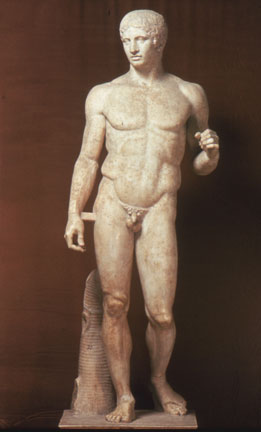
Polykleitos Doryphoros ca. 450-40 B.C. from Pompeii, marble, 212 cm. Naples, Museo Archaeologico
Why the anatomically functional figure? I regard myself as a classicist. I go back to Greece, to my experience of Polykleitos and Phidias in Naples, the real presence of the human being in art, not just the human body. If the Greeks in fact confined the human being to a few poses and to one or two points of view – station points from which to view the work – their figures feel real, existing as real presences.

With the anatomically functional figure the figure feels real from many points of view, because it is not confined to its position on the canvas or as sculpture, but communicates its capacity to move about and take other positions. Furthermore, expressively, it is not confined to a few poses and to those proportions which are defined as beautiful, but it opens up the whole range of expression through the unrestricted range of the body’s positions.


Francis Cunningham Reaching-Peter (1994-96) oil on linen 72 x 48 in.
For the Greek artist, the body and spirit are one. So they are with me, and what I have sought to do is to bring the intellect, emotion and spirit back into the body.
In comparison, the “New Realism,” as Philip Pearlstein embodied it, intentionally avoids narrative and the intellectual, spiritual and emotional life of the subject. The press release for “Pearlstein/Held: Five Decades” at Betty Cuningham gallery, November 19, 2009 – February 13, 2010, comments that, “By the late 1960’s Pearlstein had committed to the ‘New Realism,’ as stated in John Perrault’s manifesto:
No stories; no allegories; no symbols.
No hidden meanings; no obvious meanings.
No philosophy, religion, or psychology.
No jokes.
No political content.
No illustration.”

We had to have Pearlstein – we are lucky to have him – because, as he has said, “I rescued the human figure from its tormented, agonized condition given it by the expressionistic artists and the cubist dissectors and distorters of the figure, and at the other extreme I have rescued it from the pornographers, and their easy exploitations of the figure for its sexual implications.” This quote, from Irving Sandler’s essay for the Betty Cuningham show, is followed by, “Unlike painters of the nude in the past, Pearlstein continues to portray what he sees without interpretation.”
Likewise, I portray what I see without interpretation. I do not interpret, I present. Pearlstein had to strip away all the barren and sterile expressionist, cubist and neo-classical baggage that hung around the human figure. He cleared the decks. It was a prodigious achievement. It makes possible tearing down the barrier Kenneth Clark describes between the naked individual and the nude.

What I “see,” and this is tightly bound to the color-spots and the specific individual human being, has been described by Martin Sheen, the actor: “If you don’t leave home with the true sanctity of being, you won’t see that sanctity in anyone else.” I see that sanctity in every person I have painted, nude or clothed, not because I approach them from a theologically intellectualized point of view but because I am convinced and awed by the universals of geometry, arcs and angles, and the staggering uniqueness of the color-values seen from my station point, unrepeated and unrepeatable.
A friend, author and educator, on seeing the figure of Genay Sundra in Three Figures remarked, “She is a goddess.” For me, the gods and goddesses of antiquity and idealized form are as dead as they are to Pearlstein and other figure painters of today, but I have found also that they are not truly dead; they have simply moved into individual human beings. I say this not because I “think” this or would like to believe it, but because this is what I see.
Further Thoughts on the Nude: The Relationship of the Contemporary to the Classical (Part 2/3)
Continues from part 1
 Francis Cunningham Mimi Scherb (1971) oil on linen 50 x 32 in.
Returning to what is necessary in the making of an anatomically functional nude, you will need not one station-point, as with the conventional camera, but many, as in motion pictures or video. The difference is that in painting and sculpture multiple station-points are incorp
orated in one image in which the eye of the viewer does the moving whereas in motion photography multiple station-points occur by means of many images over time. In painting the life-sized figure, John Singer Sargent said you must draw it as if it were a mile away and paint it as if you were on top of it. That is because seen from a mile away (infinite distance) the parts of the body appear in their actual proportional relationships without visual distortion, whereas the color-value relationships that express the body’s forms only can be seen from close up.

Francis Cunningham Dancer - Regina (2003-04) oil on linen 77 x 54 in.
The way the artist overcomes this apparent incongruity – the body viewed simultaneously from a mile away and close up – is by employing multiple station-points in drawing or sculpting the figure. This is done by changing horizon lines and moving to the left or right of the principal vertical axis, so as to communicate the actual proportional relationships of the parts of the body one to another. It is a process that cannot be accomplished by measurement alone; it requires from the artist in addition to seeing, knowledge, and above all, empathy. The body has to feel right, and if it feels right it is right.

Francis Cunningham Jeff (with skull) (1985) oil on linen 66 x 58 in. Private Collection

Francis Cunningham Sharon (with pelvis) (1986) oil on linen 76 x 56 in.
With measurement – the pencil held at arm’s length or the caliper – as with every other aspect of painting or sculpture, if you look uncomprehendingly at nature to provide answers to the questions you pose you will not find them. The process of transcribing and presenting multi-dimensional experience onto a flat surface or into a block of stone, plaster or bronze is man-made and has no counterpart in nature.
What Sargent did not have in his painting vocabulary was the complete abandonment to visually observed color-value developed by Charles Hawthorne (1872-1930) and taught by Edwin Dickinson (1891-1978) to all of us who studied with him.
 Charles Hawthorne The Italian Girl (1910) 20 x 16 in.


Within this training, what continues to be the subject of discovery and exploration for me is the fact that observed color-spots will create tangible sensations of three-dimensional form and space. The reason for this, I believe, is not difficult to discern. Our eyes are extraordinarily sensitive in discriminating among the differences in tone, both far away and close up.
Looking out over a valley several miles away we can tell the difference in greens between a stand of pine and a stand of hemlock, a stand of white ash and a stand of maple. In nature the color-spots which the artist will abstract, appear to lie in space. They are waiting to be seen, their relationships to be abstracted and, as color-spots, placed on the flat surface of the canvas. Through these observed color-values space is described and we are drawn into that space.

Francis Cunningham Limestone Farm, Sheffield (1973) 32 x 50 in.
On the other side of the coin, close up, the perceived color-spots appear to lie on three-dimensional forms. Onto the flat surface of the canvas the artist abstracts the relationship of these color notes, duplicating in painting the information the eye needs to perceive three-dimensional form.
 Francis Cunningham (work in progress March 2010)
Like black magic, these perceived color-spot relationships on the canvas communicate sensations of sculptural form. Bernard Berenson referred to such ideated sensations of form as tactile values, considering them along with movement and space composition, to be at the forefront of qualities essential to the figure arts.

Like black magic, these perceived color-spot relationships on the canvas communicate sensations of sculptural form. Bernard Berenson referred to such ideated sensations of form as tactile values, considering them along with movement and space composition, to be at the forefront of qualities essential to the figure arts.
We have today a tool for creating sensations of form and space that has hitherto only been hinted at in Western painting. To be sure, working with the changing light of out-of-doors makes the painting process more complex in landscape than in the studio, but not impossible.

Compare distant space in a contemporary painting with how space is achieved in the Mona Lisa, in which it is suggested by conventional means – darker and clearer in the foreground, atmospherically more blue-gray and lighter as the distance recedes. Space is not continuous – there are in Renaissance art, zones of space – foreground, middle ground, background.

Raphael, Alba Madonna, oil on panel transferred to canvas, c. 1510 (National Gallery of Art, Washington D.C.)
You are looking through a window. From the Venetian painters through the 19th century, with occasional passages of what might be called color-spot painting in the precursor plein-air painters including Corot and the Impressionists, the means for creating sensations of space have been primarily conceptual and a matter of convention – perspective, scale, overlapping planes, contrasting masses of tone – not observed color-value. Observation, with the Impressionists, passed through the prism of a particular way of representing the effects of light, as conventional in its own way as is the perspectival space of the Renaissance.
 Francis Cunningham Chime Knife and Barking Spud (1970) oil on linen 28 x 44 in.
Let us not forget that space is a property of nature which we all experience and which is there to be dealt with, deep or shallow. With still life the actual depth of space may be no more than two feet.

Sheridan Lord Landscape, Autumn (1974) 40 x 70 in. The Parrish Art Museum, Bequest of Joseph Fox

Raphael, Alba Madonna, oil on panel transferred to canvas, c. 1510 (National Gallery of Art, Washington D.C.)
You are looking through a window. From the Venetian painters through the 19th century, with occasional passages of what might be called color-spot painting in the precursor plein-air painters including Corot and the Impressionists, the means for creating sensations of space have been primarily conceptual and a matter of convention – perspective, scale, overlapping planes, contrasting masses of tone – not observed color-value. Observation, with the Impressionists, passed through the prism of a particular way of representing the effects of light, as conventional in its own way as is the perspectival space of the Renaissance.

Let us not forget that space is a property of nature which we all experience and which is there to be dealt with, deep or shallow. With still life the actual depth of space may be no more than two feet.

I have discovered empirically that one can read space in a color-spot landscape or still life at a greater distance from the painting than in European paintings of the past. I have been a hundred yards from a large landscape canvas, still able to comprehend its space, whereas at this distance a painting in earlier techniques would read as a piece of colored cloth.

With the nude it is the same. One can be at a distance of one hundred feet and more and the forms of the life-sized nude will read like sculpture. At this distance the sculptural qualities of an actual human being would not be apparent for they are dependent on perceptible halftones which in nature are confused or lost at such a distance. In the nature, the figure would appear to the eye as blobs of color, as in an Impressionist painting. What is the significance of this? We may be reminded that the distance from floor to ceiling in the Sistine Chapel is 65 feet and that to make his figures intelligible, Michelangelo had to enlarge them in scale, using Florentine methods of coloration then current in order to make his shapes discernable.
There are occasionally passages of what constitutes color-spot observation in Velasquez and Eakins, but as with the plein-air landscapists these are incidents within a conventionalized whole. With Velasquez, granted the acuity and detachment of his observation, the conventions he uses are those of Baroque painting.
 Velazquez Luis de Gongora y Argote (1622)
With Eakins one may say much the same; his conventions are those of Gérôme’s studio.

With Eakins one may say much the same; his conventions are those of Gérôme’s studio.
Any and all of these assertions should be tested empirically, as I have done with my own life-sized nudes, landscape and still life, and to a lesser extent with those of others. Specifically, I have placed my work alongside several American 19th century landscape paintings as well as portraits by Chester Harding, examining viewing distances with regards to the intelligibility of form and space. But most convincingly, in a lifetime of teaching I have watched the values of form and space emerge from the color-spot paintings of beginners.
 Francis Cunningham Karen (1972-73) oil on linen 60 x 26 in. Private Collection.
Next Part 3 of 3

Next Part 3 of 3
Wednesday, February 24, 2010
Further Thoughts on the Nude: The Relationship of the Contemporary to the Classical (Part 1/3)
Francis Cunningham
December 28, 2006

I am a classicist, that is to say a lover of the classical nude. But I have on occasion argued against the classical nude in order to free the model as subject – the “daily” nude, specific, naked and individual – so that I might discover the classical nude within the daily. How have I done this? By accepting the how-high-for-how-wide of the individual person’s proportions, the particularity of the arcs and angles that constitute his or her body’s shapes, and the particular color-value relationships that describe these shapes.
Francis Cunningham Patrick (1973-75), oil on linen, 80 x 44 in.
What appears on my canvas is not the result of copying nature. It is the product of a painterly process of decision-making, one that abstracts from the visual appearance of the figure and coordinates this information with the actual proportional relationships of the anatomical parts of the model’s body.
What our eyes see and what is actually there are not at all the same. Your eye may tell you that the hand coming toward you is larger than the head behind it – the camera gives proof – but your mind knows that the hand is smaller, and by how much.
The model in front of you may be lit by more than a single light source, perhaps by as many as four or five, but if you want the body’s forms to read as three-dimensional you will select a single light source and you will then light the geometrical form-concepts that mass the model’s anatomical parts by means of this single light source. All of this is knowledge, conceptual and generalized information which the artist brings to bear on the appearance of the particular model. What we “see” is a combination of seeing and knowing.
In taking up the nude today, what is the difference between now and what was done in the past? The short answer is a world. The disappearance of the classical world view has opened up for us a new world of possibilities in terms of the ways in which a human being moves and the meaning of gestures, and also in the means for creating three-dimensional form and space.
 Jean Auguste Dominique Ingres La Grande Odalisque (1814), 35 x 64 in.
Classical art from antiquity through the 19th century was concerned primarily with ideal or idealized proportions, rhythms, pictorial organization and also with generalized color. The figures work as art, but how many classical or classicized figures do you know that can actually take a pose other than the one in which they are positioned? You may ask why would anyone want a painted or sculpted figure to be in any other position than the one they are in? Why should a painted or sculpted figure be anatomically functional and able to move about, change positions and take other poses? The answer to this is that in accepting the model as a functioning human being rather than just a painted or sculpted depiction, a whole new set of possibilities for understanding the human being, physically, mentally and spiritually, opens up – possibilities that were closed to the classical outlook.
 Francis Cunningham Regina Reclining (2003-05), oil on linen, 32 x 65 in.
 Francis Cunningham Genay Sundra Reclining (1997-99), oil on linen, 40 x 72 in.
How many depictions in classical painting and sculpture are other than theatrical, operatic statements of the “mad, sad, glad” of human emotions, as the chorographer Alwin Nikolais called them? Piero della Francesca’s silence is no less ideal in its effect – a theater of the ineloquent.
 Piero della Francesca St. John the Evangelist (1454-1469), tempera on poplar panel, 52 3/4 x 24 1/2 in. The Frick Collection.
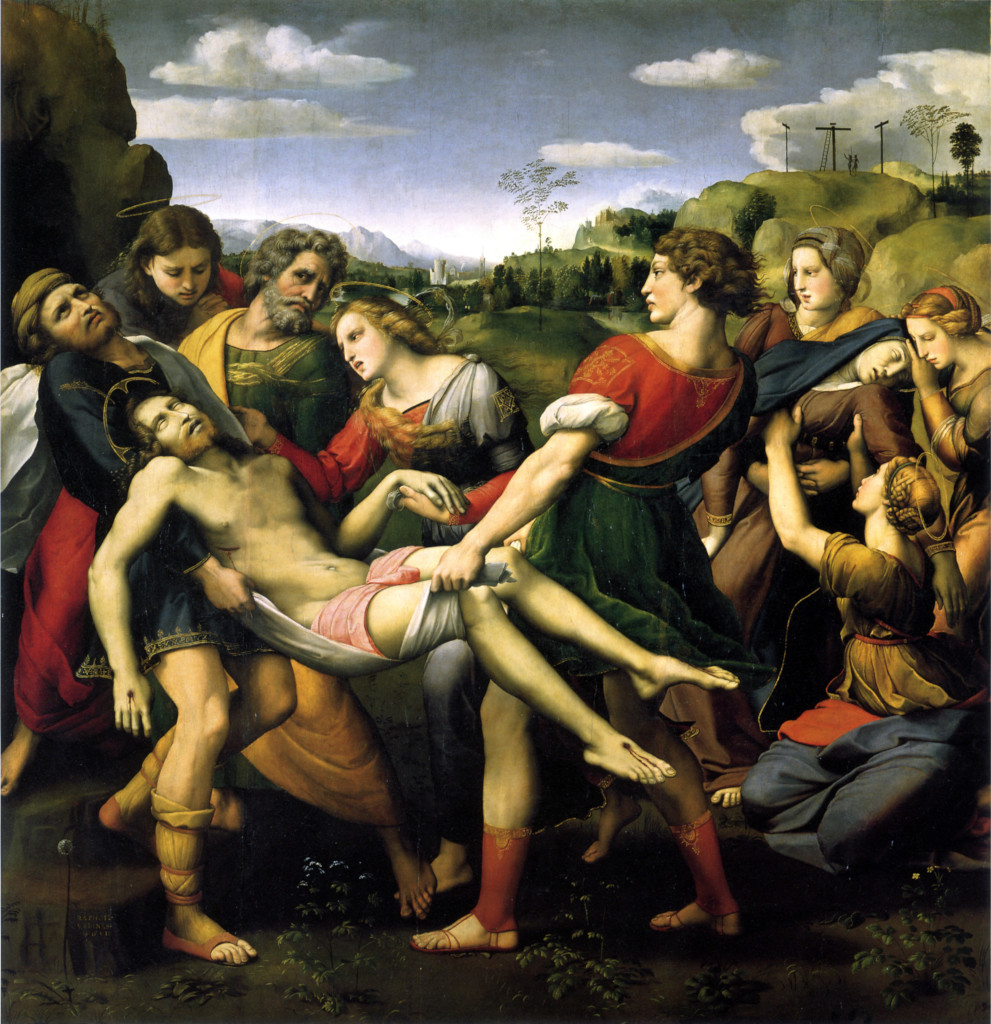
As an experiment, take Raphael’s Entombment and examine it for probability and expenditure of effort in relationship to the movement and gestures required by the action.
 Raphael The Entombment (1507), oil on panel, 184 × 176 cm. Galleria Borghese, Rome.
Take each pose for yourself. You will not be able to. [I have had students prove this to themselves.] With this exercise in hand, examine the Sistine Ceiling and the Last Judgment of Michelangelo, the figures in Delacroix’s Death of Sardanapalus and Gericault’s Raft of the Medusa, with its Michelangeloesque poses in a carefully composed pyramid.


It’s not an accident that beginning with Praxiteles’ Aphrodite in the 4th century, classical antiquity developed only seven basic poses with minor variants for the goddess of love. Can we today imagine confining the expression of love to seven poses?
 Francis Cunningham Regina (2005-2006), oil on linen 80 x 36 in.
The classical mindset from antiquity through the 19th century limited the possibilities of the nude to a small number of gestures and poses – these poses constitute the classical nude, as Kenneth Clark has described them in The Nude: A Study in Ideal Form.
Continues in part 2/3
December 28, 2006
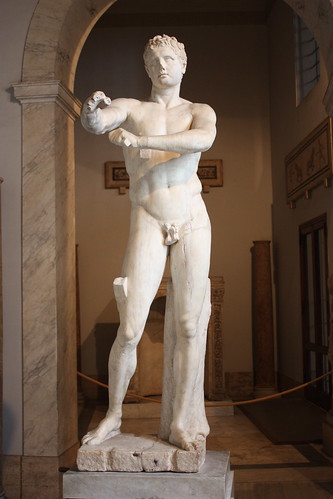
What appears on my canvas is not the result of copying nature. It is the product of a painterly process of decision-making, one that abstracts from the visual appearance of the figure and coordinates this information with the actual proportional relationships of the anatomical parts of the model’s body.
What our eyes see and what is actually there are not at all the same. Your eye may tell you that the hand coming toward you is larger than the head behind it – the camera gives proof – but your mind knows that the hand is smaller, and by how much.
The model in front of you may be lit by more than a single light source, perhaps by as many as four or five, but if you want the body’s forms to read as three-dimensional you will select a single light source and you will then light the geometrical form-concepts that mass the model’s anatomical parts by means of this single light source. All of this is knowledge, conceptual and generalized information which the artist brings to bear on the appearance of the particular model. What we “see” is a combination of seeing and knowing.
In taking up the nude today, what is the difference between now and what was done in the past? The short answer is a world. The disappearance of the classical world view has opened up for us a new world of possibilities in terms of the ways in which a human being moves and the meaning of gestures, and also in the means for creating three-dimensional form and space.

Classical art from antiquity through the 19th century was concerned primarily with ideal or idealized proportions, rhythms, pictorial organization and also with generalized color. The figures work as art, but how many classical or classicized figures do you know that can actually take a pose other than the one in which they are positioned? You may ask why would anyone want a painted or sculpted figure to be in any other position than the one they are in? Why should a painted or sculpted figure be anatomically functional and able to move about, change positions and take other poses? The answer to this is that in accepting the model as a functioning human being rather than just a painted or sculpted depiction, a whole new set of possibilities for understanding the human being, physically, mentally and spiritually, opens up – possibilities that were closed to the classical outlook.


How many depictions in classical painting and sculpture are other than theatrical, operatic statements of the “mad, sad, glad” of human emotions, as the chorographer Alwin Nikolais called them? Piero della Francesca’s silence is no less ideal in its effect – a theater of the ineloquent.

As an experiment, take Raphael’s Entombment and examine it for probability and expenditure of effort in relationship to the movement and gestures required by the action.
Take each pose for yourself. You will not be able to. [I have had students prove this to themselves.] With this exercise in hand, examine the Sistine Ceiling and the Last Judgment of Michelangelo, the figures in Delacroix’s Death of Sardanapalus and Gericault’s Raft of the Medusa, with its Michelangeloesque poses in a carefully composed pyramid.

Michelangelo The Sistine Ceiling; Cumaean Sibyl (detail).

Michelangelo The Last Judgment; St. Bartholomew (detail).

Delacroix Death of Sardanapalus (1827); detail.

Gericault’s Raft of the Medusa; detail.

Praxiteles Aphrodite

The classical mindset from antiquity through the 19th century limited the possibilities of the nude to a small number of gestures and poses – these poses constitute the classical nude, as Kenneth Clark has described them in The Nude: A Study in Ideal Form.
Continues in part 2/3
Thursday, August 6, 2009
On Mapplethorpe
UPDATE: Dick found some mistakes in my transcription of his voice mail and I corrected it.

Note the new addition on the side bar, on the right hand side, the widget with Dick's book recommendations. To start with, it contains books, which Dick either mentioned to me in our conversations or handed me to peruse. The first was Kenneth Clark's "The Nude."
It was not the first time that I came across it. In my own research on the body in the films of Claire Denis I came across this title. It's interesting how such a "classic text" can be used even for contemporary film analysis, the text I have to admit I did not use to its full potential.
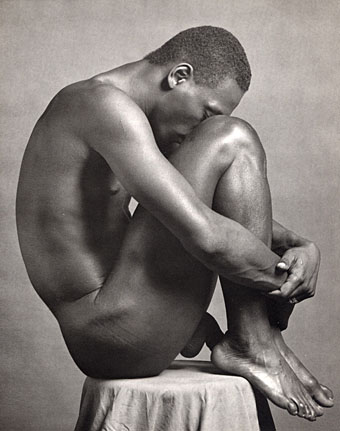
Later, Dick surprised me a bit, but not really, mentioning The Black Book . I think it's a natural due to Dick's interest in the nude. Here is what he told me he came up with before breakfast, "when often interesting thoughts occur," today and left it on my voice mail, to clarify the reasons behind his interest in Mapplethorpe's photography and in particular in his nudes.
"Whenever the human body appears in life or art, clothed or unclothed, there is an erotic potential. In art, whenever the erotic goes beyond potential to become itself the subject one may easily cross the line between art and pornography.
In art, the nude body is neutral. Sexual differentiation is a fact. Unless the artist has intended the erotic to be the subject, whatever further happens lies in the eye or rather the mind of the beholder.
For myself, the subjects of the nudes are the particular individuals, which I have painted, male and female, having 3 dimensional form in the painting as well as in life, capable of movement, and in their posture expressing the connection between their inner self and its physical manifestation.
I am interested in Mapplethorpe's straightforward nudes, not his homoerotic images or for that matter, his still lifes." Francis Cunningham 8/6/09
Finally, a title that Dick refers to in his writing a lot, but was cautious when mentioning to me for material for the blog. But I think Italian Painters of the Renaissance is a wonderful inspiration.
When on the Renaissance, there was a great show at the Met "Art and Love in Renaissance Italy", which I was lucky to see earlier this year and found it great and on top of that packed with visitors of all ages.
A quick final note to close the circle, Kenneth Clark was a great British historian, but also a TV personality, here is a DVD title, a series that covers a big chunk of European art history.
I understand the show was a hit when it was running.
Note the new addition on the side bar, on the right hand side, the widget with Dick's book recommendations. To start with, it contains books, which Dick either mentioned to me in our conversations or handed me to peruse. The first was Kenneth Clark's "The Nude."
It was not the first time that I came across it. In my own research on the body in the films of Claire Denis I came across this title. It's interesting how such a "classic text" can be used even for contemporary film analysis, the text I have to admit I did not use to its full potential.
Later, Dick surprised me a bit, but not really, mentioning The Black Book
. I think it's a natural due to Dick's interest in the nude. Here is what he told me he came up with before breakfast, "when often interesting thoughts occur," today and left it on my voice mail, to clarify the reasons behind his interest in Mapplethorpe's photography and in particular in his nudes."Whenever the human body appears in life or art, clothed or unclothed, there is an erotic potential. In art, whenever the erotic goes beyond potential to become itself the subject one may easily cross the line between art and pornography.
In art, the nude body is neutral. Sexual differentiation is a fact. Unless the artist has intended the erotic to be the subject, whatever further happens lies in the eye or rather the mind of the beholder.
For myself, the subjects of the nudes are the particular individuals, which I have painted, male and female, having 3 dimensional form in the painting as well as in life, capable of movement, and in their posture expressing the connection between their inner self and its physical manifestation.
I am interested in Mapplethorpe's straightforward nudes, not his homoerotic images or for that matter, his still lifes." Francis Cunningham 8/6/09
Finally, a title that Dick refers to in his writing a lot, but was cautious when mentioning to me for material for the blog. But I think Italian Painters of the Renaissance
is a wonderful inspiration.When on the Renaissance, there was a great show at the Met "Art and Love in Renaissance Italy", which I was lucky to see earlier this year and found it great and on top of that packed with visitors of all ages.
A quick final note to close the circle, Kenneth Clark was a great British historian, but also a TV personality, here is a DVD title, a series that covers a big chunk of European art history.
I understand the show was a hit when it was running.
Subscribe to:
Posts (Atom)